Healthcare Utilization Snapshot
Estimate demand at the block-group level and connect utilization to DRG, specialty, provider, and facility patterns.
- Demand by DRG, MDC, and specialty
- Existing physician visibility
- Facility concentration by market
Unlock precise population insights, patient demand forecasting, and location intelligence tailored for healthcare real estate decisions, facility placement, and market expansion.
What We Offer
From site selection to service-area optimization, our data surfaces the intelligence behind stronger facility location decisions.
Understand the age, income, insurance coverage, and chronic condition prevalence in any target market with census-grade precision.
Identify optimal clinic, urgent care, or specialty facility locations based on demand density and competitive saturation.
AI-driven models predict patient volume growth, service gaps, and emerging care needs across any geography.
Visualize drive-time catchment areas, access gaps, and competitor coverage to optimize your network footprint.
Break down Medicare, Medicaid, and commercial insurance penetration at the ZIP and county level to inform financial projections.
Track how demographic shifts, population growth, and health trends are reshaping your target markets over time.
Sample Report
Each report delivers a comprehensive, ready-to-present package of demographic intelligence designed for healthcare real estate teams, operators, investors, and strategists evaluating where to open, acquire, or expand.
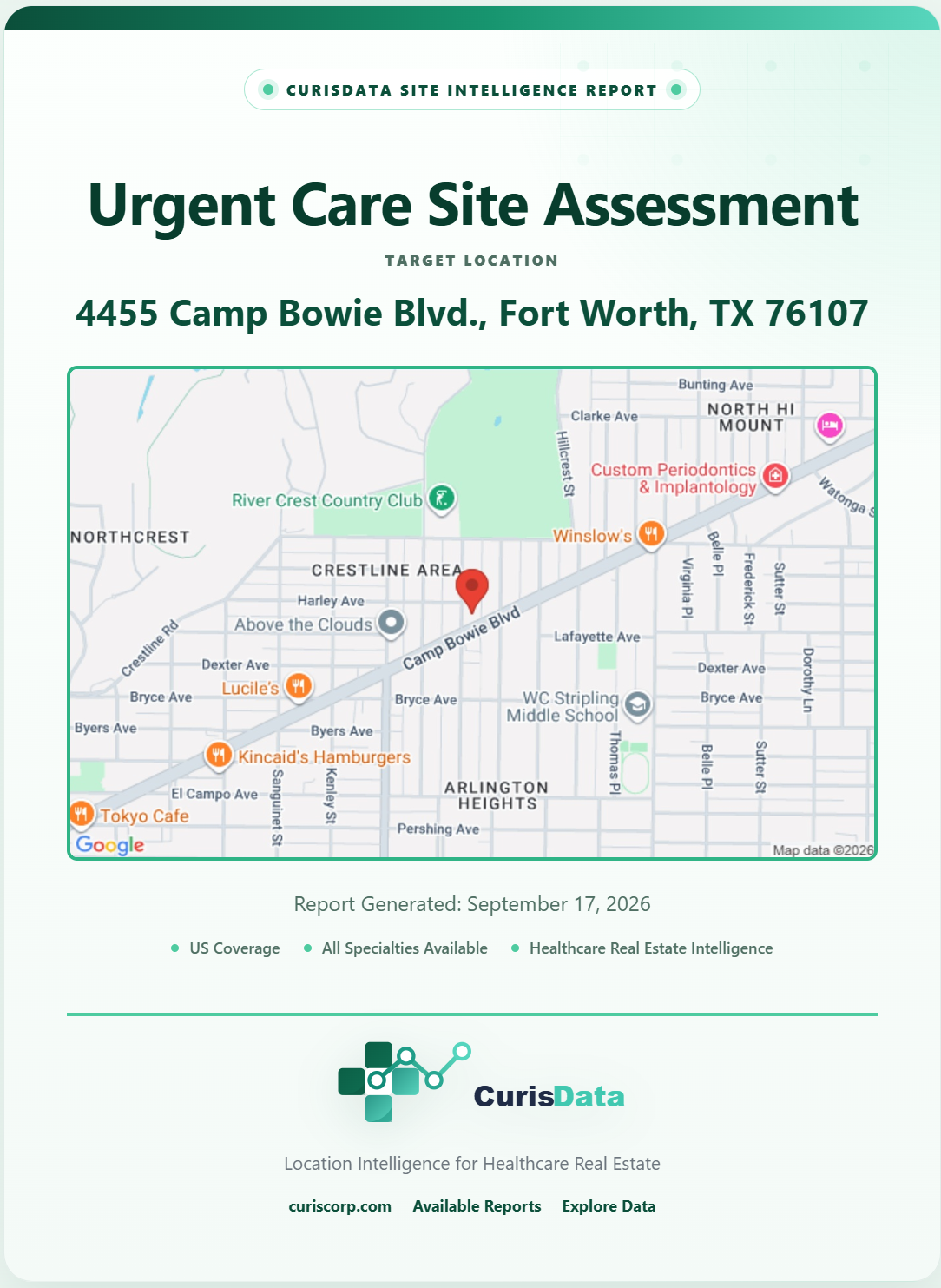
A sample of the decision-ready work product
Apps & Reports
These apps and reports help teams evaluate where demand is strongest, how competition is distributed, and which markets offer the clearest growth opportunity. They turn complex healthcare data into decision-ready views for site selection, network planning, investment analysis, and market expansion.
Estimate demand at the block-group level and connect utilization to DRG, specialty, provider, and facility patterns.
Profile the competitive healthcare footprint in a study area with a cleaner summary of the facilities that matter most.
Compare candidate or competitive sites against known performers using a practical scoring workflow.
See who is in-market, how specialties are distributed, and where affiliations shape referral gravity.
Translate service-line demand into maps, tables, and charts that make trade-area decisions easier to explain.
Support custom appends, predictive analysis, and enterprise workflows without adding software overhead.
Methodology
CurisData models demand by combining observed healthcare use rates from visit data with government survey and demographic inputs to estimate near-term market demand and develop a five-year forward view.
We blend historical utilization patterns with government survey data, demographic structure, payer context, and market-level variables to estimate likely demand at a more usable geographic level.
Claims data can be valuable, but its timeliness, coverage, and clinical detail can vary. Because it reflects care already delivered and billed, it is inherently retrospective. CurisData instead models demand using observed visit data, government survey inputs, demographic structure, payer context, and market-level variables.
A clearer basis for site selection, service-line planning, expansion strategy, and investment underwriting with both current-year demand estimates and a five-year forward view.
Pricing
Start with a single market report, request volume pricing for multiple markets, engage us for tailored analysis, or discuss enterprise data access for your own systems. Early engagements are analyst-produced and delivered with a defined turnaround window.
A low-friction starting point for one target market or location, produced by our team and delivered in a polished, decision-ready format.
Built for site comparison, expansion screens, and portfolio planning when your team needs multiple reports delivered in a coordinated batch.
Flexible, high-touch analysis for complex healthcare real estate questions, specialty-specific work, market entry strategy, and portfolio decisions.
For organizations that need CurisData demand intelligence inside their own systems, analytics workflows, or client-facing products.